Two condos sit a few minutes apart at Dairy Farm. A 1,033 sq ft three-bedder at The Botany at Dairy Farm resold in September for $2.38 million, or $2,303 psf. A 1,152 sq ft four-bedder at Narra Residences, still under construction, is advertised from about $2.45 million, or $2,125 psf. On paper, one more bedroom costs about $68,000 more, at a lower price per square foot.
The two numbers are measured differently. The Botany's 1,033 sq ft is "non-harmonised"; Narra's 1,152 sq ft is "harmonised". Roov explains what that means, why it makes the bigger home look cheaper per square foot than it is, and what it means if you are buying to live in or to invest.
What "harmonised" means
Until 2023, the agencies that measure a building each used their own definitions. URA counted floor area for planning, SLA counted strata area for the title, and BCA and SCDF had their own rules. In September 2022, URA announced one common set of definitions, agreed with SLA, BCA and SCDF. It applies to development applications submitted from 1 June 2023.
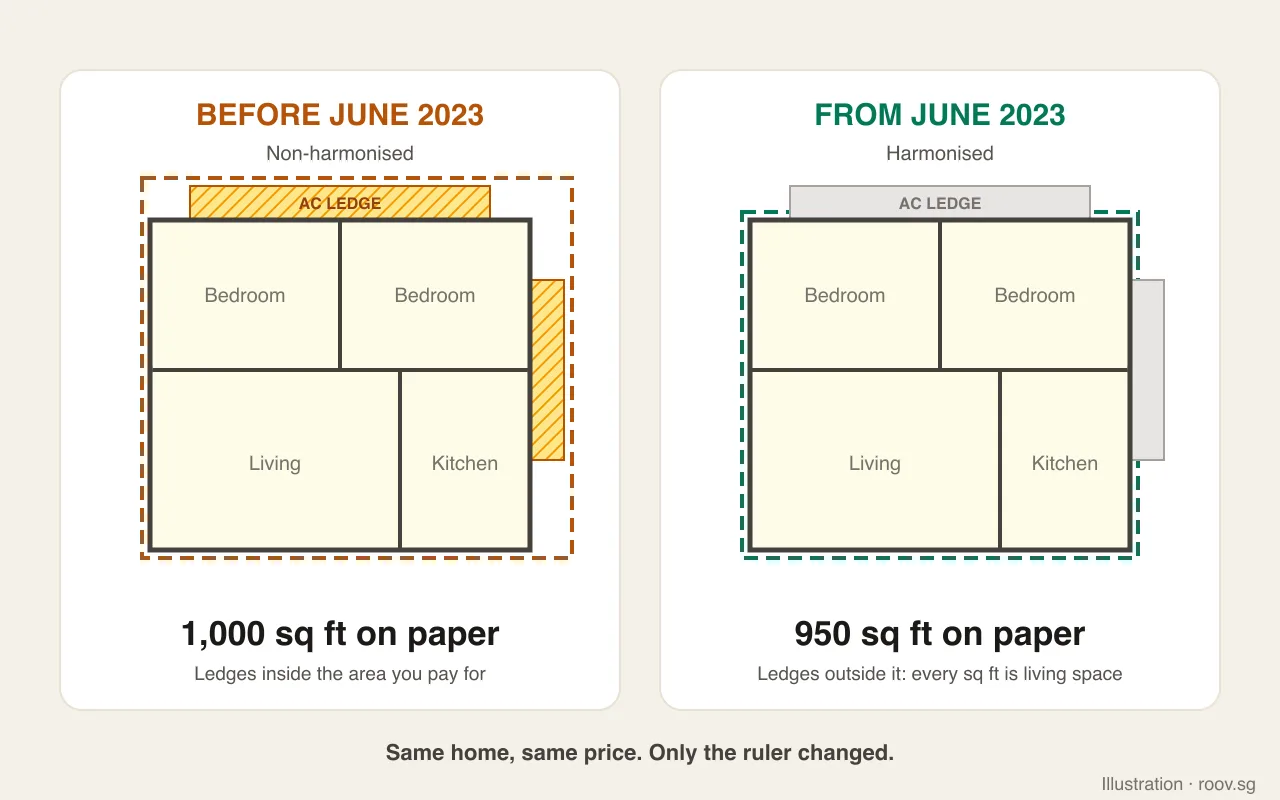
The change buyers notice is about air-conditioner ledges. Under the new rules, everything sold to you as part of your unit counts against how much the developer is allowed to build. So developers stopped selling you the ledge. It is still outside your window, holding the compressor, but it is no longer part of the area on your title, or the area you pay for. Voids, such as the space above a double-height living room, are no longer sold as area either.
So:
• Non-harmonised: projects approved under the old rules. The area you buy can include air-con ledges and other space you cannot live in. Every condo completed so far follows these rules, and so do many still being built, including The Botany, which launched in March 2023. • Harmonised: projects that applied from June 2023. The area is closer to the space you actually live in, balcony included. Narra's floor plans mark the air-con and RC ledges as "non-strata", outside the area sold.
The same home and the same price can therefore show a higher psf under the new rules, simply because it is divided by a smaller number. Our guide to floor-area harmonisation works through the arithmetic.
Dairy Farm, measured properly
Roov's records of URA caveats show both projects in full:
• The Botany at Dairy Farm (non-harmonised, lease from 2022): 93 of its 1,033 sq ft units sold new at a median of $2.09 million, or $2,018 psf. One has since resold, in September, at $2.38 million. • Narra Residences (harmonised, lease from 2025): 11 of its 1,152 sq ft four-bedders have sold since January, at a median of $2.60 million, or $2,255 psf. The cheapest are advertised from about $2.45 million.
The Botany's floor plan puts an air-con ledge and RC ledges inside its 1,033 sq ft. We don't have its strata plan, so take a range. If those ledges add up to 40 to 80 sq ft, the space you can live in is about 950 to 990 sq ft. At $2.38 million, that is about $2,400 to $2,500 for each square foot you can use.
Set against that, Narra's $2,125 psf for its cheapest four-bedders is about 12 to 15 per cent lower per usable square foot, not 8 per cent as the printed figures suggest. Even at its median of $2,255 psf, Narra costs less per square foot you can live in. The real gap in space between the two homes is also bigger than the 119 sq ft on paper: something like 160 to 200 sq ft.
So the comparison in Narra's favour holds, and is stronger than the brochure numbers show. But it is not the only difference:
• Timing. The Botany is finished, and you can move in now. Narra's lease began in 2025 and it is still being built, so you will pay rent or stay put for a few more years. • Payment. A resale unit needs the whole loan at completion. A new launch is paid in stages as it is built, under the progressive payment scheme. Roov's progressive payment tool shows each stage against your cash and CPF. • Lease. Narra's lease started three years later, so it has three more years left.
Good or bad?
For buyers, mostly good. You no longer pay for ledges and voids you cannot live in, and a new launch's psf is closer to the truth. The catch is that psf history now has a break in it. For years, harmonised and non-harmonised condos will sell side by side, and any psf comparison across the 2023 line, in a brochure, a chart or a valuation, compares two different rulers.
For developers, it is a trade. They can no longer charge for ledge space, but every square foot they sell is now one a buyer can use, so they price each one higher. The land does not get cheaper, though. For anyone reading a land bid, the same land cost is now recovered over more sellable area, which is why Roov's guide to land bids and launch prices uses a higher sellable share for harmonised projects.
If you own a non-harmonised unit, your psf looks lower than a nearby new launch's. That can make your unit look like a bargain next to a launch, so quote both figures when you sell. But don't assume the launch is "worth more per square foot" on the printed numbers alone: part of the gap is the ruler, not the value.
What to check before you buy
• Compare the price for the same layout first, and psf second. • Ask for the strata plan, not just the brochure, and see whether ledges are inside the area. • For a non-harmonised unit, divide the price by the space you can actually use before comparing it with a launch. • Remember stamp duty is charged on the price, not the area, so the stamp duty calculator gives the same answer whichever ruler was used.
Roov's resale versus new launch comparison puts two homes side by side over your holding period. The market tool shows each project's psf as URA records it, so you can see which side of the 2023 line a project sits on. The next Dairy Farm site, awarded this year at $962 psf ppr, is in the GLS tracker. For how a new launch's psf compares with resale nearby, see our look at Thomson Reserve's launch weekend.
Weighing a harmonised launch against an older resale unit, and want the real space and price per square foot worked out for both? Roov's agent can run the numbers with you. Get in touch.